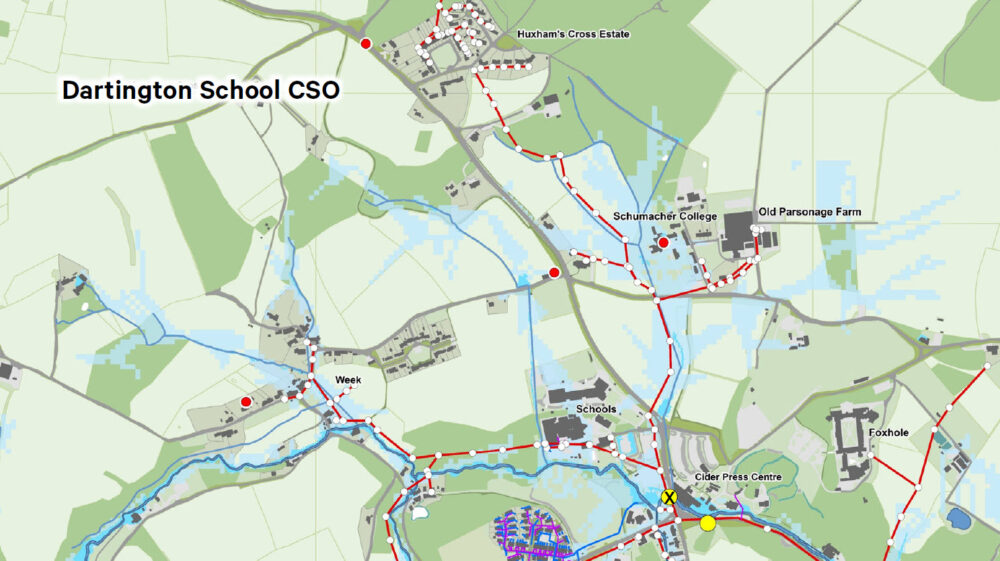
For those of us who live, work, and spend time in Dartington, our connection to our landscape and rivers runs deep. But like many places across the UK, our rivers are facing challenges from a wide range of factors which can affect water quality. We know that to protect and improve water quality, we all need to play our part, and for South West Water (SWW) this includes investing record amounts in making improvements to our sewerage system.
Climate change, population increase and building developments all put pressure on our sewage system. After periods of heavy or prolonged rainfall, there is sometimes too much water in the system. Storm overflows are designed to act as safety valves by discharging automatically into the sea or a river when this happens. This protects properties, businesses and streets from flooding. The process is strictly regulated by the Department for Environment, Food and Rural Affairs (DEFRA) and the Environment Agency. You can find out more about storm overflows at www.southwestwater.co.uk/storm-overflows.
Investing in Your Local Area
We know that we need to do more to reduce our use of storm overflows and we are doing more than ever to tackle these issues head on. We have recently announced a record £3.2bn of planned investment across our region between now and 2030. Our plans include reducing the use of storm overflows, to achieve less than 10 spills per year, per overflow, by 2040, a decade ahead of the Government target.
We will assess all possible storm overflow solutions using our new Green First framework, which considers and prioritises nature-based solutions (NbS), rather than reverting to more traditional engineered, or grey, solutions. This is our approach to improving water quality in the Bidwell Brook.


What Has Happened in Dartington so Far?
Over the past two years our dedicated teams have been investigating the water quality of the Bidwell Brook through the Dart and Tavy Pilot scheme and the recent monitoring programme, where we have assessed various contaminants, from a range of sources, in the brook. Citizen scientists have also been monitoring the water quality of streams in the catchment. The overall ecological health is promising, and we are continuing to reduce any impact from the local storm overflows.


What’s next…?
We are working with trusted partners such as the BBP, Westcountry Rivers Trust (WRT), Dartington Estate, Devon County Council and others to assess the potential of NbS in the Dart Catchment around Totnes. We will be working together to take the four storm overflows in Dartington through the Green First framework, assessing how we might be able to use NbS to reduce their use and further protect the water quality of the river. By slowing down and managing water naturally, we can help prevent some spills from happening, while also supporting wildlife, reducing flood risks and enhancing the local landscape.
Over the coming months, we’ll be continuing to work on fully understanding the challenges and opportunities in Dartington, ensuring that the solutions we develop are ones that residents, landholders, and community groups both need and want. Our Green First approach in Dartington won’t just deliver technical fixes, but will ensure sustainable, community-driven change, which achieves what is right for people and nature in the long term.
Playing your part
And don’t forget…what we put down our drains has an impact on the sewer system. Every year across the region, we clear around 6,400 blockages – and about 75% of these are caused by fats, oils, greases, and wet wipes.
When these harden in the network, they can cause blockages and fatbergs which can lead to flooding, pollution, and costly repairs. That’s why it’s so important that only the three Ps – pee, paper and poo – are flushed down the loo, and that we keep fats, oils and greases out of our drains by disposing of them into the bin.
You can find out more about helping to prevent blockages at www.southwestwater.co.uk/household/your-services/your-wastewater/caring-for-your-sewerage.